Showing posts with label Google. Show all posts

Wednesday, February 22, 2012

What to expect at MWC 2012 from Google

Next to Samsung and Microsoft, Google is probably one of the biggest players at this year’s Mobile World Congress 2012 expo.
Never ones to disappoint, Google has even launched a microsite that counts down the days, hours, minutes and seconds until things officially get underway.
So what will Google be launching?
This is a good question. But it’s one without any real concrete answers, at present. For instance we can’t see Google launching another Android update, having only released Ice Cream Sandwich four months ago.
Then there's the fact that Android 4.0 is only powering about one per cent of Android devices with the rest being on Gingerbread, Honeycomb and Froyo.
So whatever Google launches will come as a surprise. Here's our breakdown of what the search could potentially launch or debut at MWC 2012.
Chrome for Android announcement
Google is currently in the process of folding aspects of its Chrome OS into Android 5.0 AKA Jelly Bean for the purpose of dual booting the operating system on Windows 8-powered notebooks, tablets and netbooks, according to leaked information for Asia.
Jelly bean
Could this mean that Google will demo some aspects of Android 5.0’s features ahead of its official launch at its I/O 2012 event in June? It’s possible – not particularly likely, mind you – but still kind of in the realm of possibility. It’d also detract from Canonical’s MWC launch of Ubuntu for Android, which sets out to do something very similar to what Google allegedly has in mind for Jelly Bean.

Google Music 
Google announced Google Music at its 2012 Google I/O developer conference. Originally called Google Music Beta, the service offered Android users the ability to store their music collections on Google’s cloud servers and stream then down to any gadget carrying Android.
Google announced deals with Universal Music Group, EMI, and Sony Music Entertainment when it launched the service. But what Google failed to confirm was when the service would be available for users outside the US. It’s been almost seven months now and we’re still none the wiser here in the UK.
Fortunately there is a way around Google’s isolationism, which you can read about here.
So is an EMEA launch of Google’s Music service on the cards for MWC 2012? Maybe – Google does need to push the service out across Europe. And what better way to confirm this than at MWC 2012 in Barcelona?


Nexus Tab
Google chairman Eric Schmidt confirmed not so long ago that the company is working on a premium-grade tablet device, dubbed the Nexus Tab, which will apparently hit markets in Q2 of 2012.
Speaking to Italian newspaper Corriere della Sera, Schmidt said: ‘In the next six months we plan to market a tablet of the highest quality.’ Schmidt made this comment back in December 2011. Six months on from December is June, which is when Google’s I/O 2012 event is scheduled to take place.
nexus
Now, we fully expect Google to launch the Nexus Tab, along with Android Jelly bean, at I/O 2012 in June – that’s pretty much a given. But could we get a preview of the slate at MWC 2012? We’d say there’s something like a 20 per cent chance of that happening, which aren’t exactly great odds. Still though – 20 per cent is better than nothing, right?
Google Home Entertainment device
Not so long ago we reported that Google was working on an Android-powered Home Entertainment system that would act as a general hub for your TV, smartphone, stereo and tablet. We imagine it’ll be a lot like Apple TV just with fewer restrictions and more features. It’d also be nice if Google made it cross-platform as well so you could use it with Windows Phone and iOS-powered devices too.
Here’s our report from February 10:
‘The Wall Street Journal claims that Google Inc. is developing a home-entertainment system that streams music wirelessly throughout the home and would be marketed under the company's own brand.'
'There are a variety of Android applications and computer-based programmes already available that will work in conjunction with Google’s Android platform but this is the first time Google has been officially linked with an Android home-entertainment project.’

The WSJ claims that Google will release the Entertainment Hub ‘later on in the year,’ which could mean Q4, Q3 or next month. This means that a possible demo of the product or, failing that, an official statement regarding the product, could very well be on the cards for MWC 2012.
Google X Glasses
Last but not least on our dubious list of possible MWC 2012 Google launches is the search giant’s much talked about Android-powered X Glasses. Little more than a month ago reports emerged suggesting that Google’s X Labs were working on a set of Android-powered glasses that utilised augmented reality.
Since then the internet has been aflame with Android aficionados discussing and speculating about just what was possible with a pair of Android-powered spectacles. Personally we think the idea is stupid – but at least Google’s trying something different.
X-Glasses
A more recent report in The New York Times has now surfaced regarding Google’s X Glasses, which claimed that the glasses will have a low-resolution built-in camera that will be able to monitor the world in real time and overlay information about locations, surrounding buildings and friends who might be nearby, according to the Google employees.
The report said: ‘Internally, the Google X team has been actively discussing the privacy implications of the glasses and the company wants to ensure that people know if they are being recorded by someone wearing a pair of glasses with a built-in camera.'
Allegedly the glasses are currently being developed in Google's secretive, high-tech and improbably named ‘X Lab'.
The report claimed the glasses will ‘tap into a number of Google software producst that are current available and in use today,' but will use a heads-up-display (HUD) to show the information in augmented reality:
‘The glasses will send data to the cloud and then use things like Google Latitude to share location, Google Goggles to search images and figure out what is being looked at, and Google Maps to show other things nearby, the Google employee said.'
One source reportedly stated: ‘You will be able to check in to locations with your friends through the glasses.'
The New York Times said Google doesn't currently have a planned business model for the glasses. Instead this is a very experimental project. Supposedly Google will launch the X glasses ‘as is', gauge the consumer reaction and then plan around that.
We’d love to see these spectacles in action at MWC 2012. Unfortunately the likelihood of this actually happening is pretty damn slim, considering that Google has yet to even officially confirm that it’s even working on such a product.


Tuesday, February 21, 2012

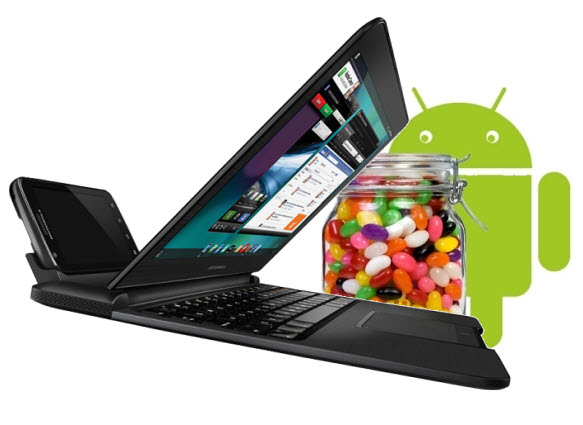
Android 5.0 Jelly Bean Brings Native Lapdock Capabilities for Full Desktop Apps


It looks like Google may be borrowing a page from Motorola Mobility’s playbook ahead of the completed acquisition of the smartphone-maker. With Android 5.0 Jelly Bean, it is now speculated that Google will be bringing Lapdock-like capabilities with the next iteration of Android with scalable, full-screen apps.

In a prior report, there were speculations that Android 5.0 may bring dual-booting capabilities with Windows 8, but according to Mobile-Reviewblogger Eldar Murtazin that won’t be the case. Murtazin’s rebuttal makes sense as Google wants to compete with, not collaborate with, Microsoft, and there are already a number of third-party solutions to dual-boot or emulate Android on top of Windows.


This makes sense as many third-party app developers allow users to purchase smartphone apps once and they can also download a tablet-optimized version of the app with higher resolution graphics and an improved user experience for larger screens for free. Android 5.0 could store both the smartphone app and the tablet-optimized app on the device and launch the tablet version when placed in the correct docking accessory. This would create a powerful mobile OS that can scale as needed on the go. This also matches what Google is attempting to do with the Chrome browser for Android, including full-screen browsing.

Right now, the thing that constrains Motorola’s Lapdock ecosystem is RAM as the Lapdock itself is a dumb accessory without any power. It’s just a keyboard, trackpad, large display, and extended battery. Procoessing power, memory, storage, and wireless access is handled through the phone itself, and Motorola’s Atrix and Droid phones definitely feel the slow down with just 1 GB of RAM.

We’re also beginning to see a lot more hybrid form factors on the market, such as the transforming Transformer from Asus or the Padfone.

It’s unclear if the solution may cannibalize tablet sales; Google’s tablet manufacturers are already struggling to move Honeycomb tablets. The move can also take away from sales of Windows-based ultra books and notebooks.

Via- unwiredview

Monday, February 20, 2012

Microsoft claims Google is bypassing Internet Explorer privacy settings


Last week, it was revealed that Google and other leading advertising companies had been bypassing the privacy settings of millions of unknowing Safari users. The Mountain View-based company maintained its innocence and claimed it “used known Safari functionality to provide features that signed-in Google users had enabled.” Microsoft is now claiming that the search giant has used a similar technique to bypass privacy settings in Internet Explorer. By default, IE blocks third-party cookies unless the site provides a “P3P Compact Policy Statement” indicating how the cookies will be used and agreeing to not track the user. Microsoft claims that Google is improperly representing certain cookies, which allows them to pass through IE’s security without disclosing the company’s intent. Google has not responded to Microsoft’s claims.

Cloud Music Sniper brings your Google Music library to any music player


There is absolutely no doubt that Google Music is a fantastic service to have, if slightly limiting at times. The music stored in your cloud locker is only ever available to the official Google Music app which is frustrating for some. Oh for a world where Poweramp or Winamp could access all that music. Well that world is now, and Cloud Music Sniper can bring your music to your chosen music app. 
The previous incarnation was known as Google Music Sniper, but was suspended due to its name. The new version requires no root, and works by 'sniping' your offline synced music content and storing it in a new directory. This directory is then available to your alternative music player. The music is actually available to be taken off your device and used on your desktop computer. To the user it is as simple as firing up the app and following some on screen instructions. 
Cloud Music Sniper is still in the early stages, and the developers are known for constantly updating their apps, so there should be plenty more to come. If this sounds like something for you, it'll run you for $1.99/£1.26 in the Android Market. Download links can be found after the break.


Google working on voice controls for TV, files for patent

Put down that remote. Google TV is about to bring a whole new dimension to being a couch potato. Soon, not even your fingers will have the benefit of channel surfing calisthenics. A newly uncovered patent suggests Google has some big things in the future when it comes to interacting naturally with your television. According to the patent, which was filed right around the launch of the iPhone 4S and its Siri virtual assistant, the Goog is cooking up a way for a user to simply ask as questions such as “When is Seinfeld on?” and be treated to the same results Google TV already provides.
While there is no telling how deep the service might go, on its surface it sounds a lot like Android’s Voice Actions tailored to TV. The patent mentions the ability to trigger voice commands using certain phrases, allowing users to channel surf without ever touching the remote. Diving deeper we find descriptions of a cloud-based system that uses the user’s smartphone to decode voice into text, send the information to the cloud to be processed, and then complete a process on the television set.

Saturday, February 18, 2012

Handtec offering unlocked Galaxy Nexus at £349


Handtec, the British retail website, is offering the Samsung Galaxy Nexus at GBP 349 (roughly $550) unlocked. They’re only taking pre-orders as of now, but the shipment is said to be due in soon.
Although it’s still quite a bit of money, it’s the best deal for an unlocked version that I’ve come across so far. The earliest expiring auction on eBay shows the current bid at $600, and that’s with 10 hours still to go. VAT does raise the cost to GBP 419 for UK residents, and international customers need to keep shipping costs and import duties in mind.
Place your order through here.

Friday, February 17, 2012

Google and other advertisers used ‘a special code’ to bypass Safari privacy restrictions

Google and other leading advertising companies have been bypassing the privacy settings of millions of unknowing Safari users, reports the Wall Street Journal. Using “a special code,” the companies were able to bypass the browser’s privacy restrictions and install cookies on a user’s computer, even when such actions were supposed to be blocked. Companies such as Google use cookies to track browsing habits across websites that it places advertisements on. Apple’s Safari Web browser blocks these third-party cookies by default, only allowing them on a website that a user directly interacts with. Read on for more.
The Journal’s research found that this “special code” was present in 22 of the top 100 websites when browsing from a computer, and 23 sites when using the iPhone’s browser. The publication notes that “once the coding was activated, it could enable Google tracking across the vast majority of websites.”
The Mountain View-based company has maintained its innocence, claiming its advertising cookies do not collect personal information. “The Journal mischaracterizes what happened and why. We used known Safari functionality to provide features that signed-in Google users had enabled. It’s important to stress that these advertising cookies do not collect personal information,” responded a Google representative.
Vibrant Media, Media Innovation Group and PointRoll all employed a similar code for tracking. Out of all the companies, Google has the largest market share, delivering Internet ads that were viewed at least once by 93% of all U.S. Web users in December. Apple reached out to The Journal and informed the publication that the company is “working to put a stop” to codes that bypass Safari’s privacy settings.

Google privacy settings, hides cookies in Safari for iPhone


Google is caught up in what has the potential to be a rather large privacy scandal. The company has acknowledged using a hack in ads served by its Google Ads/DoubleClick service that allowed it to bypass a privacy setting in the iPhone and iPad's Safari browser. This hack allowed Google to place a cookie, a small bit of tracking code, in Safari when it normally wouldn't have been allowed.


The issue is that the hack allowed Google's ad servers, as a "third party site," to set the cookie. It is normal behavior for sites that a user visits directly to set cookies. We do it here on MobileBurn.com. It allows sites to keep you logged in, to use your preferred settings, or just to ensure that traffic statistics are accurate. But Google was setting the cookie without the user visiting Google's website directly.

Google's intent in doing this was not to track users for advertising purposes, though. Rather it was a work-around that would allow Google+ users to press the +1 button that appears on ads served by its network. There's nothing particularly nefarious about what Google was trying to do here, and the cookies it placed in Safari were set to expire after no more than 24 hours.

When Google detected that a user was logged into Google+, it set a cookie that would allow the user to hit the ad's +1 button. When the user was not an active Google+ user, it also created the cookie - but left it blank. Google said that this was done to effectively annonymize the data - making all users look alike.

This technical two-step had a side effect that Google admits to not having anticipated.

That side effect is that advertisements that use Google's ad network now had a foot in the door. This is because once a site has a cookie set on a browser, it is generally allowed to set additional cookies - no matter which site is being visited when they are set. This allows for features like Facebook's 'like' button to operate on non-Facebook sites. But now Google advertisements were setting their own cookies that would have been prohibited before, and they could be set with their own expiration dates that could keep this door open indefinitely.

Google's Rachel Whetstone gave The Wall Street Journal the following statement about this side-effect:

"We didn't anticipate that this would happen, and we have now started removing these advertising cookies from Safari browsers. It's important to stress that, just as on other browsers, these advertising cookies do not collect personal information."

The Journal reported that other advertising networks were using the same Safari hack to set cookies, and that ads containing the hack were appearing on major websites across the country. Including its own.

An Apple spokesperson told the Journal that it was looking to put a stop to this security hole in its Safari browser.

Gooroovster brings Google Music to Windows Phone


Google Music, Google’s online music locker service, allows you to access music from pretty much any device that has a web browser. But as we all know, most web apps have limitations when compared to native apps and at the moment there is no official Google Music app for Windows Phone. A developer has decided to solve the problem by creating their own Google Music app called Gooroovster.

Available now on the Windows Marketplace, it gives users a way to access the music service through a native app. All users have to do is login to their Google account and they’re good to go. In addition to browsing through music by songs, artists, and albums, support for playlists is included as well. Judging by the reviews posted on the app’s Marketplace entry, it looks like users aren’t disappointed as well.

Gooroovster is available now for $3.99 (Google Music account needed) and there is a trial version that is available for free. Head over the Windows Marketplace to download it.

Wednesday, February 15, 2012

Google Android Hits 50 Percent Of Smartphone Market Share


Google’s Android platform is continuing with its incredible growth, and according to a recent report from Gartner, for the fourth quarter of 2011, Android made up 50.9 percent of all smartphone sales worldwide.

In second place is Apple’s iOS with a share of 23.8 percent, in third place is Symbian with an 11.7 percent share and in fourth place is RIM and their BlackBerry OS which had an 8.8 percent share of the market.


According to the reports there were a total of 75 million Android devices sold in the last quarter of 2011, this compares to a total of 35 million iPhone from Apple.


Overall out of all mobile phone sales Nokia remains top with a total of 111 million devices sold Samsung are in second place with a total of 92 million mobile phones sold and Apple are in third place with a total of 35 million iPhones sold.

Source The Next Web

Tuesday, February 14, 2012

Happy Valentine’s Day, Phandroids! Google Celebrates With New Video Doodle


Whether you’re spending Valentine’s Day alone or with your that special someone/device, Google has a new Doodle on their homepage that is sure to warm everyone’s heart. Must be dusty in my house because every time I watch, I get something in my eye. Whether it’s with their wonderful mobile OS or with one of their Doodles, Google always has a way of getting me right here (points to heart, er– eye).


I’m still not sure if it’s possible to fall in love with a multi-billion dollar corporation but if this wrong, I don’t want to be right. Happy Valentine’s Day, everyone. You guys have anything special planned?

Google-Motorola Mobility purchase approved by US Department of Justice


The European Commission gave the Google-Motorola Mobility deal the green light yesterday, and not long after, it looks like the US Department of Justice has decided to follow suit as well. According to the Department of Justice; “After a thorough review of the proposed transactions, the Antitrust Division has determined that each acquisition is unlikely to substantially lessen competition and has closed these three investigations”.

This brings Google one step closer to owning Motorola Mobility – now all the company needs is the approval of China, Israel and Taiwan to proceed. So there’s still a chance that this purchase isn’t going to fall through. In addition to approving the Google-Motorola purchase, the Department of Justice also approved the recent joint purchase of patents from Nortel by Google, Apple, Microsoft, RIM and others.

No word on when Google will get the approval of the other three nations, but we’ll be sure to keep you posted when it does.

Monday, February 13, 2012

Google, YouTube ,Gmail blocked in Iran


Out from the horse’s mouth – the Republic of Iran has blocked Google’s encrypted search, Gmail service, Google Videos and YouTube since February 10th. This is no small news, as over 30 million Internet users in Iran have not been able to gain access to their e-mail accounts, and Gmail is not the only one affected, as Microsoft’s Hotmail too, has been affected. It is rather weird to have Iran’s Information Technology Organization and the Telecommunication Infrastructure Co. mention that they are unaware of the issue. According to state-run news agency Mehr, any problems that arise from this move has nothing to do with them at all. What do you think of the this move – how will it affect Google’s coffers negatively, and more importantly, how else are the students in Iran supposed to get their homework done without Google? Definitely unimaginable in a first world country, but then again, that might be why Iran is not part of the first world country group.


Thursday, February 9, 2012

Google confirms 2.25 percent fee for Motorola patent licensees


In a letter sent by Google to the president of the IEEE in an effort to convince him that Google's proposed purchase of Motorola would not cause any issues with patent licensing, the company indirectly confirmed the 2.25 percent royalty fee that Apple claims Motorola asks of its patent licensees. Google also said that the 2.25 percent of per unit sales fee would continue to be the maximum that it would demand from licensees when it completes the purchase of Motorola and absorbs its patent portfolio.

Apple initially took issue with 2.25 percent figure that Motorola asks from those that wish to license its patents, as it said that it was outside the realm of fair and non-discriminatory (FRAND) licensing terms. Indeed, when you do the math, the 2.25 percent fee amounts to $15 to $19 of what the retail cost of the iPhone 4S is - a pretty significant sum for a single patent license. Apple argues that if Motorola is able to demand that much for its FRAND patents, there is nothing stopping other companies from doing the same and bringing the telecommunications device industry to a grinding halt.

Google has promised that it will also honor Motorola's existing policy of negotiating "good faith" terms with business partners, and that it will not litigate against those who are willing to license its patents.

"Transparency and consistency in licensing practices are important with respect to standard essential patents, and the IEEE and its rules play a critical role in promoting those goals," said Google Deputy General Counsel Allen Lo, who penned the letter. "I am confident that Google's acquisition of MMI will not disturb those goals or otherwise adversely affect the IEEE, its members, or the implementers or consumers of its standards

Google to launch cloud drive service says WSJ


Google is set to release their own shared cloud storage solution, says the Wall Street Journal.  Their insiders have said that Google will soon launch called "Drive" will rival Dropbox in functionality, being able to "store photos, documents and videos on Google's servers so that they could be accessible from any Web-connected device and allows them to easily share the files with others."  It sounds like it will have some overlap with Picasa, Google Docs, and Youtube, but at this time nobody has all the particulars.  
The new service, expected to launch in the coming weeks or months, will be free for most folks, businesses included.  Google will only charge those who want to "store a large amount of files", so there will be a premium service with more capacity.  If Google does release this one, we would certainly expect it to hit Android devices soon after.  Could this be the big thing at Google I/O this year?
Source: WSJ


Tuesday, February 7, 2012

Google launches Chrome browser for Android smartphones and tablets [video]

Google on Tuesday announced the first beta release of its Chrome Web browser for Android-powered smartphones and tablets. The firm’s native Web browser is certainly among the better mobile Web browsers on the market, but with Chrome, Google is focused on aligning its mobile browsing experience more closely with its desktop browser. “Like the desktop version, Chrome for Android Beta is focused on speed and simplicity, but it also features seamless sign-in and sync so you can take your personalized web browsing experience with you wherever you go, across devices,” Sundar Pichai, Google’s SVP of Chrome and Apps, wrote in a post on the company’s blog. Chrome for Android is available immediately as a free download in the Android Market and it is compatible with smartphones and tablets running Android 4.0 or later. An introductory video from Google follows below.

Google Augmented Reality Glasses Arriving Soon


The 9to5 Google website has revealed this week that Google’s new augmented reality glasses could be arriving very soon. Providing users that wear the new “Google Goggles” as they have been dubbed. Information as they walk along provided by Google location services and Google’s stored information. A source has now revealed to the 9to5Google website that the new Google glasses look similar to Oakleys Thumps glasses and are equipped with a front a facing camera.


Inside the glass lens there will be a heads up display (HUD) which is located in front of one eye and provides relevant information at your current location. The source also suggests that the I/O on the glasses will also include voice input and output, and hardware is near the equivalent of a generation-old Android smartphone, with CPU, Memory and storage provided onboard the glasses.

“They are in late prototype stages of wearable glasses that look similar to thick-rimmed glasses that “normal people” wear. However, these provide a display with a heads up computer interface. There are a few buttons on the arms of the glasses, but otherwise, they could be mistaken for normal glasses.

Additionally, we are not sure of the technology being employed here, but it is likely a transparent LCD or AMOLED display such as the one demonstrated below: In addition, we have heard that this device is not an “Android peripheral” as the NYT stated.

According to our source, it communicates directly with the Cloud over IP. Although, the “Google Goggles” could use a phone’s Internet connection, through Wi-Fi or a low power Bluetooth 4.0. The use-case is augmented reality that would tie into Google’s location services. A user can walk around with information popping up and into display based on preferences, location and Google’s information. Therefore, these things likely connect to the Internet and have GPS. They also likely run a version of Android.”

Unfortunately no information on pricing or worldwide availability has been released as yet, but as soon as information comes to light on the new Google AR Glasses we will keep you updated as always.

Apple and Google took 90 per cent of smartphone market in Q4


Smartphone sales grew once again in Q4 of 2011. And, as you’d expect, Google’s and Apple’s Android and iOS platforms took the lion’s share of the market, accounting for 90 per cent or sold handsets.

The stats come via a report by The NPD Group, which claimed that ‘together, Android and iPhone accounted for over 90 percent of smartphone sales, with Android holding on to 48 percent of the smartphone market during the quarter.’

What’s more surprising, though, is that Android is the most popular operating system with first-time buyers.

‘Based on the latest data from The NPD Group’s monthly Smartphone Track service, among the first-time smartphone buyers in Q4, 57 percent purchased Android phones compared to just 34 percent who purchased iPhones.’

Apple still had a good, however, according to NPD – The iPhone 4S outsold the iPhone 4 by 75 per cent.

Led by continued steady sales for Apple’s iPhones,’ says NFD, ‘the top five best-selling mobile phone handsets in Q4 were as follows:
Apple iPhone 4S
Apple iPhone 4
Apple iPhone 3GS
Samsung GALAXY S II
Samsung GALAXY S 4G

Apple is expected to unleash the iPhone 5 in Q2 of 2012, which will no doubt lead equally ridiculous sales figures in Q3 and Q4 of this year.

Luckily for Android it’s got Samsung to fall back on. Granted the Galaxy S III won’t shift as many units as the iPhone 5 but it will still fly off the shelves and go on to be the second most popular handset of the year (we’d wager)

Monday, February 6, 2012

Google Earth Update Removes Grid Where Atlantis Link Started


If you came across some revived Atlantis attention, well it’s because of some undersea grid found by some Google Earth users.

Google Earth recently allowed users to take a look at terrain under the sea and some were able to make out some grid-like pattern which resembled city streets. And just like that, Atlantis was back for another round of revived talks.


Turns out, however, the grid was only caused by overlaying data sets coming from sonar data to map the ocean floor, and not city streets as some would like to believe. Google has updated its app and the grid that started it all has been removed.

Google also made some tweaks on its ocean mapping and is now more accurate. Google Earth has also expanded its sea floor area viewable on the app, as it is now at 15% from the previous 10%.

Via: Slashgear


Samsung Galaxy Nexus in White lands 13 February


A long time ago in a Galaxy far away there was a phone that was all set to be the third Google branded Nexus instalment. That phone, you may recall, leaked several times under the guise of the Google Nexus Prime.

Alas, the Nexus Prime wasn't to be though, as the Samsung Galaxy Nexus came forth and stole official Google status when it was announced back in October. And now, just in time for Valentine's Day (there's nowt more romantic than a téléphone blanc, right?), the white Galaxy Nexus is set to hit shops.

The Galaxy Nexus features a 4.65-inch HD Super AMOLED display technology at 720p resolution and a 1.2GHz dual core processor. It's just 8.94mm thick, with a minimal 4.29mm bezel around the edge and features software navigation buttons, a first for Android smartphones.

There Ice Cream Sandwich débutante also has a redesigned 5-megapixel camera which boasts panorama mode, 1080p video capture, zero-shutter lag, and image effects.

Samsung's Simon Stanford said: "After much speculation, we are pleased to announce the availability of the Galaxy Nexus white which follows the great reception the phone has received since it was launched back in November.

"One of the things we at Samsung pride ourselves on is the choice we offer customers, and we’ve enjoyed huge success to date by introducing white variants of our most popular models to our product portfolio."

The Samsung Galaxy Nexus, in white, will hit shops on 13 February.